Apr 2, 2009

Blog Temporarily In HIatus

Dear Readers;
Buddhist Mama is in temporary hiatus, while I focus on my main blog, Breechmama.  I look forward to seeing your comments there.  In the meantime, peace & blessings to all you Zen Mamas and Zen Papas out there. I hope to be back this summer when I am back in Ladakh. 

Nov 6, 2007

A 29 weeker in Ladakh

The delivery room at Sonam Norbu Hospital was as crowded as the Palden Lhamo chapel during one of Ladakh's biggest winter festivals, the annual Spitug Gustor. It was only 10 am and it was standing room only. Dr. Padma, who had just gotten off the plane from Delhi that morning, waited as a woman whose bare thin calves poked out from under a bulky North Face jacket climbed up on the rusty steps to the delivery table. The jacket was a logical outfit. It was early April and nighttime temperatures inside the hospital might well sink into the 50’s.

Chime had arrived in early preterm labor at 3 am already 3 cm dilated and there was little the staff could do to slow the labor. There is only one doctor on call at night for a district hospital that serves a region one and half times the size of Denmark. In this case, the doctor, an internist with no experience in obstetrics or pediatrics was unfamiliar with the protocol for tocolytics to slow a woman's labor or prenatal steroids to help speed up fetal lung maturation. As a result, by the time Dr. Padma saw her, the patient was 10 cm dilated, 100% effaced, and her amniotic sac about to burst.

Which it did did as Dr. Padma performed her internal exam. She grimaced as the dark meconium stained fluid splashed over her pants and onto the floor. The color of the amniotic ‘liquor’ indicated possible fetal distress and were grounds for immediate delivery, she later explained. Yet she was concerned as the ultrasound from the previous night indicated a gestational age of 29 weeks and the patients’ chart suggested an even earlier date of 26 weeks.

Dr. Padma told Chime her baby had only a 15% chance of survival at this point and that the baby should be born as quickly as possible. I was reminded of my own precipitous labor almost 3 years earlier when I saw the terror in Chime's eyes. I, too, had found myself in a hospital in an emergency labor, with my waters broken, far earlier than I ever expected. I, too, was in labor when I was warned uncertain prospects my twins would face at 26 weeks. While I'm glad I was told the truth, I don't think there is any easy way to break this kind of news to a woman in preterm labor.

Dr. Padma immediately called for an IV and oxytocin, which might speed up the mother’s labor and also prevent post-partum hemorrhage, one of the most common causes of maternal death in both India and Tibet. A nurse placed the catheter, which failed to drip, until Dr. Padma noticed and cleared a dangerous bubble in the IV line, and then injected the syringe of synthetic oxytocin into the IV bag dangling above Chime’s head. The dose she administered---less than 1 mililiter of oxytocin per liter of IV saline----was lower than the standard US low dose oxytocin protocol that is used in over 70% of births in the US.

However, even these protocols have been associated with uterine hyperstimulation, uterine rupture, and fetal hypoxia. The Wall Street Journal 97/21/2006) reported that even insurance companies are trying to reduce the over-reliance on synthetic oxytocin or Pitocin in American obstetrics, as the drug is implicated in over half of all obstetric malpractice claims that involve birth trauma. These claims make obstetrics one of the most claim-ridden and costliest specialties in medicine from the perspective of insurance companies.

Chime tired after two hours of pushing ---for she been up the entire night in the throes of labor, then traveling to the hospital, never mind the panic of what must have felt like a horribly wrong time to be having this baby. But with Dr. Padma’s encouragement and the nurses scolding, she managed at last to push her son out.

When her son was finally delivered, he was much bigger than expected at 1.6 kilos, but almost non-responsive. His color was dusky, he wasn't breathing, and had no obvious reflexes. His apgars of 2,4, and 6 at one, five, and ten minutes, reflected the concerted efforts of the hospital’s best obstetrician and pediatrician. He was transferred back to packed obstetric ward a half an hour after birth and given best treatment the Leh hospital had to offer---100% oxygen by improvised nasal canula, suctioning, and intramuscular antibiotics. Less than 24 hours later, he died of a brain bleed (probably IVH, or intra-ventricular hemorrhage). Chime was devasted and discharged the same day.

Why write about this incident?

Because giving birth involves very similar and very different forms of suffering for women and infants, each and every day, depending on where they live on our crowded little planet. I honor the suffering that women in Ladakh experience who have no access to NICU's as much as I respect the difficulties that women in the US face, with some of the best medical care in the world.

Mar 30, 2007

Going to the Field, No Internet

There will be no new posts for the month of April. I am headed up to Ladakh on March 31 for a few weeks of fieldwork and will be off the internet. Not that there aren't cyber cafes in Leh but I'll be too busy to use them. I won't be able to get into Zangskar as the passes are deep under the snow and the avalanche danger is too great this time of year. Then we pack up and move back to the US, along with several hundred kilos of stuff we seem to have mysteriously acquired during our year in India. Skalzang is coming with us to the US.

This is her first visit outside India and Nepal. I can't wait to see what she thinks of the US. Not only that, but she is the first Zangskari person to visit the States as far as I know. Not just the first woman, the first Zangskari period. A nice step for Zangskari feminism.

Why toddlers cry, a Zangskari analysis

Just the other day I had a chat with Skalzang about why toddlers cry. Skalzang, who is one of my oldest friends from Zangskar, is spending the year with us here in India, and has had much opportunity to see Tashi and Krishan have tantrums.

It was interesting to learn that there are two Zangskari words for the crying of toddlers and infants. One, nyid shrin, literally translates as 'sleepy crying', while the other, stod shrin, translates as 'hungry crying'. So there you have it---a simple theory about why babes/toddlers cry---they are either hungry or they are sleepy. Or both. Not sure what word is used in that context. Sure put things into perspective for me; I think I'll try and forget the hundreds of reasons that cause me endless worry and aggravation. It is not that those reasons aren't at fault----but they are more than likely to be in combination with 'sleepy crying' or 'hungry crying'.

I have to hand it to Skalzang, a nun, for clarifying this parenting issue for me!

Mar 21, 2007

Second twins at higher risk

A new study has just been published in the British Medical Journal (BMJ) that claims that second-born term twins are twice as like to die at birth or shortly after birth as first born twins. This finding reflects a relative risk, not an absolute risk which remains very small. It also does not hold for premature twins.

The Atlanta Journal Constitution (3/2/07) reports
" 'I would hate to see this study used as an excuse to have every mother with twins have a Caesarean section,' said Dr. F. Sessions Cole, the head of the neonatal intensive care unit at St. Louis Children's Hospital."

Yet this is precisely my fear. How many doctors will use this study to push mothers with twins into having cesareans? The author of the BMJ study, Gordon Smith, says that cesareans lower the risk for second twins and the research study concludes: "the findings of this and other studies suggest that planned cesarean section may be beneficial for all twins." However the key word is MAY.

This conclusion runs head into an ongoing debate about the best way to deliver twins. Medical opinion is divided on whether cesareans are protective for all twin deliveries . A rather large debate remains, especially when it comes to premature twins or twins that are not headfirst. Yet that debate rarely makes it into the news. when it does, an expert is usually called up to "interpret" the findings.

Our expert here is Dr. Cole, who is quoted as saying that the study applies more to Britain than the US, because we monitor twins better in the US. I think a few British obstetricians might object to this generalization. Dr. Cole also states that most doctors are happy to deliver twins vaginally in the US. This is hardly the case. Between 50% and 90% of twins are delivered by cesarean, depending on their orientation. I'm not talking about sexual preference here. In the twin literature, orientation refers to the twin's position in the uterus: headfirst ( vertex), breech, or transverse. The latter two are likely candidates for a cesarean according to some studies, while this is debated by others.

It is good that Dr. Cole is questioning automatic cesareans for all mothers with twins. Yet the rate of obligatory cesareans for twins is rising in the US and elsewhere. In the US, roughly 60% of all twin pregnancies will include one twin who is not headfirst. This amounts to more than 79 thousand babies a year in the US. Many women with twins where one is headfirst will have little choice but to opt for the 'planned' cesarean their doctor recommends. They won't find a doctor willing to risk a vaginal delivery.

This is what happened to me. My second twin was transverse. I went to the four best and most vaginal-friendly obstetric providers I could find in a 100 mile radius. Not a single OB even entertained the thought of a vaginal delivery. Not the OBs in the hip, feminist, pro-lesbian town of Northampton, nor the crunchy, earth-mother practice in southern Vermont. Luckily, I delivered accidentally into the hands of one of the few doctors on the East Coast who was comfortable with a vaginal breech delivery of twins at 26 weeks.

Studies disagree about the safest mode of delivery in my case---when only twin B is breech and preterm. A French study shows that vaginal delivery is as safe if not safer for twin deliveries, regardless of presenataion or gestational age. Here is the Pubmed abstract of the 2006 study.

So why are so many doctors afraid to deliver breech twins vaginally? Because of the hostile legal climat they labor under, but also because the newer generation of obstetricians has less and less experience delivering twins or breeches (and god forbid, both combined!) vaginally. The public, too, is to blame for wanting a perfect birth and not understanding the very real risks of breech and twin deliveries.

My brilliant obstetrician gives me some hope. But what happens as the younger generation of OBs take over, few of whom have seen or done a vaginal delivery of a breech or twin birth?

Mothers of twins, esp. breech twins----read those scientific abstracts. It may be that a cesarean is safer in your case. It may be that a vaginal birth is safer. It may be that nobody really knows. But don't take one doctor or one expert as the final word.

PS. My second twin actually did better than my first twin. Yeah, yeah, only anecdote. But guess how many cases were responsible for one of Gordon Smith's earlier conclusions? Nine births!!

Jan 9, 2007

Part II: Two Births, Two Twins, Two Boys.

Two boys, both twins, my son on right, my friend N's son on left.

I’ve been thinking about my friend N, who delivered her boy-girl twins, one of which was breech, vaginally, just like I did. However, there were some important differences.

N delivered her full term twins at home in rural Zangskar at 12,000 ft, attended by her sister, a midwife, and another birth attendant. Her labor and delivery took all of six hours.

I delivered my twins at 26 weeks in a stainless steel operating theatre at Dartmouth hospital, attended by no less than four obstetricians, several residents, three anesthesiologists, two neonatologists, and a dozen nurses. I was in early and intermittent labor for four days, and active labor for 27 hours.

N received a single shot of muscle relaxant called epidocin (valethamate bromide) used to relax the cervix and speed up dilation.

I had hoped to deliver naturally, without drugs. "What drug are you on?" the doctors and residents implied every time I mentioned this wish. Despite my considerable resistance, I was given: obligatory magnesium to slow the labor (not necessary as studies on tocolytics have showed, and quickly abandoned once it was discovered I had PROM), antibiotics to prevent infection (mainly because the resident had botched my GBS culture and so there was no way to tell if I needed them), IV fluids for rehydration (I'd have preferred water), steriod shots to hasten fetal lung development (very good), pitocin to speed up my labor (very bad), and an epidural shortly before the twins were born (still not sure i needed it to stay still as both twins were tiny and my son slipped right out), when my amazing obstetrician pulled out my daughter, a footling breech.

If we had switched places at the moment of our births, N would have surely been delivered by cesarean, in a hospital. Almost 95% of all those that present as breech like N's twins, wind up as cesarean deliveries. In cases like mine, where the second twin is breech, studies have shown vaginal delivery to be as safe as cesarean. Despite this fact, nearly one half of all twins are delivered by cesarean section in America.

If I had delivered my twins in Zangskar, they probably would not have survived. Nor would my own health have been assured, as I went into labor very prematurely due to placental abruption, or pre-partum hemorrhage. In Nepal and Tibet, almost half of all maternal deaths are caused by hemorrhage. The same is probably true for Zangskar, but there are almost no current statistics on maternal or infant mortality in the region. We do know that India and Nepal have some of the highest maternal mortality rates in the world---540 and 589 per 100,000, respectively. Zangskar’s infant mortality was last estimated at 250 per 1000 in the 1994.

It's too easy to get lost in statistics. Consider, then, the home birth of twins in the Himalayas.

***

Neither N nor her sister Lhaskyid, the midwife, was sure N was having twins nor a breech until the day of her delivery.

When Lhaskyid performed her first internal exam, shortly after N went into labor, she discovered two things in rapid succession. First, N was already ‘two fingers’ (3 cm) dilated after only an hour of labor. But the real surprise lay beyond the cervix. Rather than the comforting roundness of a head, she felt buttocks. As she manipulated her fingers around to be sure, she felt the little one’s lingam and almost cried out. Not because he was a boy, and she had just touched the organ that signified this. But because this baby was not headfirst.

She had delivered many breeches in her life, but none of them twins, and always with a backup helper. She knew the problems a breech could cause---the cord could squeezed or tangled and cut off oxygen to the baby, or the head or shoulders could get stuck on the way out. Even more critically, Zangskar's only labor room, at the primary health clinic where she worked, had no emergency facilities for a cesarean. The nearest hospital was an 18-hour drive away, over a high pass that still lay under several feet of snow.

L finished her exam, smiled, and told her sister she would soon have the baby. Then she went into the next room to think. She sent her mother off to call Karsha's most skilled birth attendant, a medical assistant, while she made some butter tea.

The medical assistant was perplexed when he arrived. Lhaskyid had delivered many babies in her life and usually did so on her own. Why had she called him. When he performed his exam, he nearly gasped, but kept his face as straight as possible for N's benefit. Maybe it helped that he talked to Lhaskyid in Urdu rather than Zangskari so that N never suspected anything. Maybe it was that N never realized she had twins until after the whole thing was over and so she wasn’t overwhelmed from the beginning. Maybe it the fact that two very experienced birth attendants knew as much to follow the ‘hands off the breech’ policy. A few short hours, the twins were born, an hour apart, in perfect health.

In the first year after their birth, N's twins had a few bouts of fever and diarrhea. My twins spent the first three months in the Intensive Care Nursery at Dartmouth Hospital with very few complications and showed no signs of prematurity at the end of twelve months.

Both sets of twins, for very different reasons, outwitted the odds against them.

N's birth, Part I

N with her twins, Stankyong and Tsering

In some ways, N's delivery and my own were uncannily similar.

We were both old to be having our first child, we both had twins, we both had them vaginally, and one was breech.

We were both outside the full day, having delivered babies in early May after a long, cold winter. But here our paths diverge.

Unlike me, N knew she would give birth at home, as her five older sisters had. Moreover, her sister–––a trained midwife with over 20 years experience across Zangskar–––would be her primary birth attendant. While my sister had helped deliver babies in a rural hospital in Uzbekistan and had worked for years in reproductive health, I don't think she would jump at the chance to deliver my twins at home.

Unlike me, N had conceived her twins naturally without drugs or other interventions. In fact, she didn't know she was having twins until the night they were born. She hadn't seen a single obstetrician or ultrasound technician during her entire pregnancy. Her first indication came at at six months when Lhaskyid, the midwife, noted that her belly was riding too high and out front for a single birth. N was so scared she wished this thought away the moment it was uttered.

Unlike me, N's exercise the day she went into labor had not been yoga, but watering her fields. She was laboring long before she knew she was in labor. She delivered on one of the busiest times of the year, when the entire village is engaged in 'first watering' or sgrol chu. This involves racing up and down sinous waterways to open and close the 'mouths' of the channels that wind their way through the landscape bringing wate to the barley fields. Climbing along this vast and spidery web of channels and subchannels is a strenuous job, even when the sun is not burning overhead.

It was her turn to go out from dawn to dusk, flooding each and every field, square meter by square meter. Flood the field too fast, and the seedlings are damaged; too slow, and your fields won't get done by the time your turn is up in the village-wide water rights scheme by which each household gets just enough water for its fields.

When N came back at the end of the day, she felt a slight ache in her back, but assumed it was just soreness from bending over the fields with her shovel all day. She said nothing, but fell asleep shortly after dinner in the kitchen while her sister cleaned up. A few hours later, L heard N cry out in her sleep.

“Ahhroohwahhh. Ahroohwahhh.”

When L heard this cry, she guessed that N was in labor. This was no random lament but one scripted for female pain, especially for labor. This cry is mostly by women and often to signify suffering above ordinary or mundane pain. It is a polite way of registering agony that does not disturb the mask of stoicism women wear in Zangskar.

L got up and looked around the kitchen for the implements she might soon need to use. Once she found a match and lit the kerosene lamp, she began to boil some water for tea. While N stayed snug in her warm blankets, L dug around in the cluttered shelves until she found her syringes and the ampules of glucose and epidosin (a muscle relaxant to relax the cervix that she used more and more often). She had sent them over to Karsha two weeks before her arrival, just to be safe. N heard her bustling about about next door in the parlor laying out a new set of rugs, a plastic sheet, and then some clean blankets for the imminent delivery.

It wouldn't do to deliver in the kitchen, N knew. The hearth was a sacred space for both the thab lha mo or hearth goddess and the subterranean klu, both of whom were responsible for household fertility and were offended by the blood of birth. While women are banished to the stables to avoid offending the klu on the Tibetan plateau and nearby Kargil, N was free to labor inside her home, in not the warmest but perhaps the cleanest room of the house.

Dec 27, 2006

three sisters


The three Tinguling sisters have a lot of experience when it comes to Buddhist birthing. L, on photo right, is a midwife with 20 years experience, who delivered alll of the children in this picture, safely, at home, with minimal medical equipment or drugs. N, who stands in the middle of the back row, is holding one of her twins, while her sister, K (on the far left) holds the other twin, and stands in front of her own children, daughter Nyima and son Thayas.

Dec 9, 2006

I get by with a little help from my friends

Ani Skalzang Lhamo, my first roomate at Karsha nunnery. An amazingly patient woman, she is a far better parent than either I or Ashok. But she is committed to lifelong celibacy, and so she's not planning on having kids, in this lifetime at least or the next, when she's hoping to be reborn as a monk.


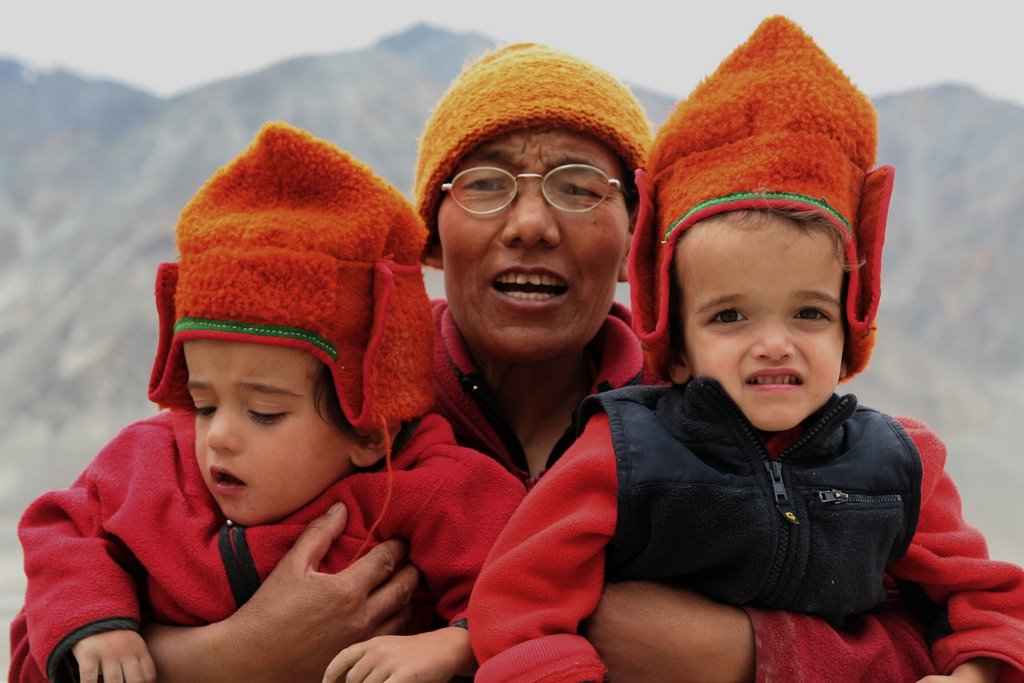
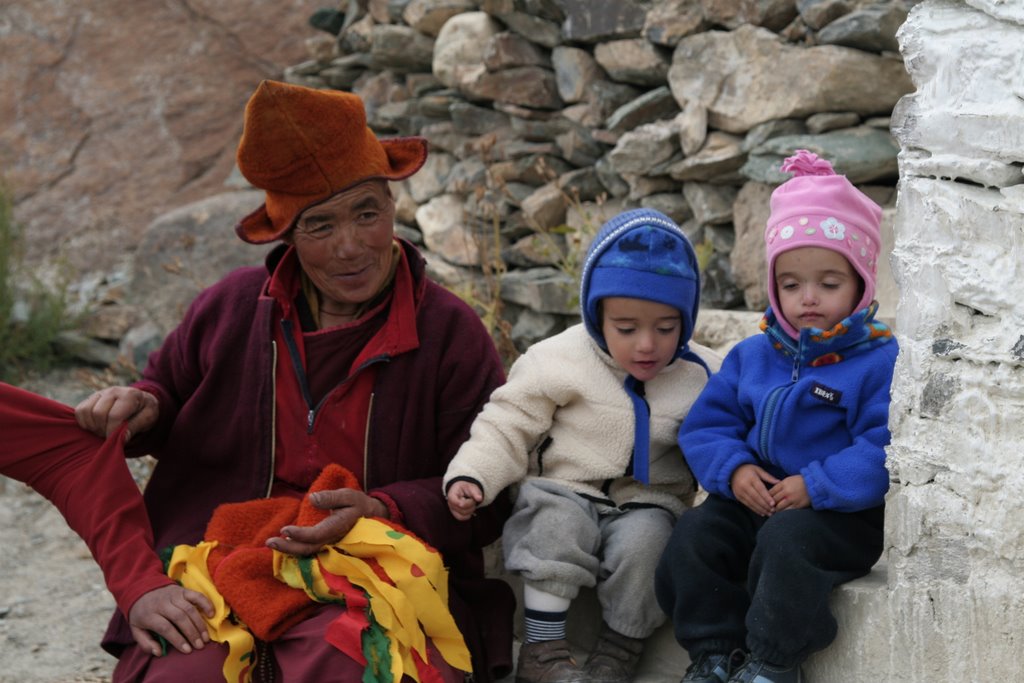
Ani Putid, one of my 'aunties' and mentors at Karsha nunnery, helps Tashi and Krishan familiarize themselves with our backyard. They are sitting on the steps of one of the oldest temples in Zangskar, owned by our gracious host, the Karsha Lonpo.


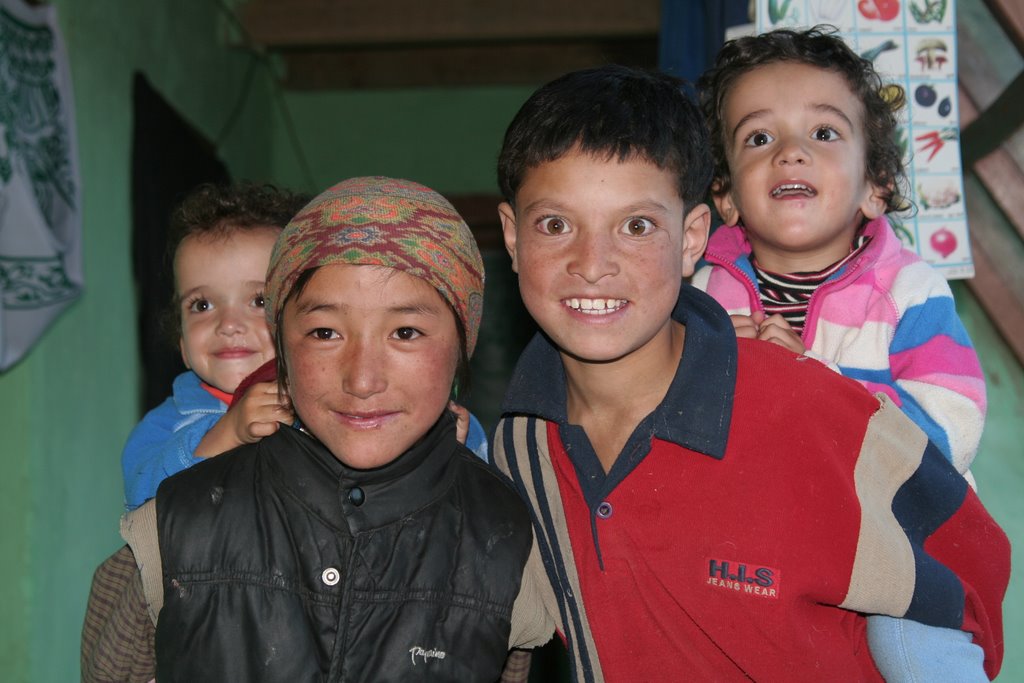
Our neighbors, Sonam and Stobldan, were a whole lot better at taking care of little kids than the average 10 year old in the States. It didn't hurt that they were older and wiser than my twins and had not been spoiled by having too many toys in their life.

potting training in the himalayas

Warning: this post has offensive language and images. Not for the squeamish, unless you have potty trained a child...

There are a few drawbacks to starting potty training on a cliff in a desert, where the water supply is spotty at best. On good days, the water came to the cliff via a 1 inch diameter black rubber pipe, for an hour or two or less. That is whenever the Nepali laborers who were "fixing" or "improving" the water supply had not accidentally or intentionally disconnected the pipe or rerouted it for their construction purposes. There is a certain haste and intensity to these projects as they can only happen between May and October in Zangskar, before the Nepali workers leave and the streams freeze up. Given that everyone is fighting over the same water, for a range of uses, during a very short work season, you can begin to imagine the subtle, but always Buddhist, tensions in water sharing.

Back to potty training. The cloth diapers and rags, as well as dishes, pots, and pans would pile up through the day as we did other things like fetch the water from the pipe. Often there would be a pile of soiled diapers outside our door under a rock, so that the stray dogs would not get at them. In Zangskar, many stray dogs eat shit, as food is scarce. Even if, like our strays, they live near a nunnery or monastery where kind nuns or monks are constantly setting aside ritual dough figurines or throwing out leftovers, the dogs are still hungry.

On not so good days, when Tashi and Krishan had diarrhea or had decided to poop OUTSIDE not inside the potty, things got a bit more complex. Suddenly, we were playing the game of "where is that poop". In other words trying to find the places that Tashi and Krishan had been after or during their poop. It was highly likely there was poop spread on all kinds of other surfaces including, but not limited to clothes, hands, rugs, walls, etc. We had dirt floors and it isn't easy to clean poop off dirt floors. All of this required more and more water. You begin to see the crux of our problem. Sometimes there was a toss-up between whether to clean the floor, or do the dishes, or cook up a meal. Or at least decide which took priority.

I had a huge burst of compassion and insight into the lives of rural women in India, whose children often get diarrhea, even as they struggle to keep their kids and houses clean. I've read some public health literature pertaining to the problem of diarrhea, which continues to be one of THE MAJOR causes of infant mortality in India and other parts of the 'developing' world. Some people may rant that this problem is entirely preventable if more people (they usually mean women who are taking care of most infants) had ready access to clean water, public hygene awareness, and literacy.

I would like to note that our household had all these things and we were still unable to prevent at least one member of our household from getting diarrhea once a week. Our household was entirely literate, AND aware of basic hygene methods (excepting Tashi and Krishan), AND, we had fairly ready access to mostly clean water. Ok, there was the odd fact that everybody in the village was suffering from dysentery and we all used the same collection tank upstream of the village. But the water in that tank was clean enough, or as clean as its going to get in rural Zangskar for a very long time. In the meantime, Tashi got sick pretty much every week, Krishan every fortnight. Mom and Pop were sick only once a month, mercifully.

I have a huge amount of respect and appreciation for what many mothers in India are up against. They may be trying to keep track of two or three kids, with a limited water source that may be an hour's walk away or rationed due to scarcity (as in urban India where water may arrive by truck but be strictly rationed by household). Furthermore, the actual water kept in the household is limited by the size and number of storage containers available. One tends to forget that if you don't have running water, every drop brough to the house has to be stored, preferably in a clean pot. You should have seen the frantic filling of pots and other containers wheneverthe water pipe was functioning. Ashok once joked that the arrival of water seemed on par with the arrival of the Dalai Lama in Karsha. He was worried about what might happen if the Dalai Lama and the water showed up on the same day??

So, I now understand a lot more about how impossibly hard it is to keep infants (or adults) free of dysentery in rural India.

Dec 6, 2006

Our neighbors on the cliff in Karsha

NK with her daughter Deskyid, who is the same age as my twins. NK is my "nomo" (ie. younger sister) and her father, the Karsha lonpo, is my mentor, teacher, host for our visit to the cliff above Karsha.


We sit in the hallway of the Lonpo's modest medical institute with NK's husband P; his daughter Deskyid; my twins, Krishan and Tashi; and our roomate, Skalzang, who is also P's half-sister.


The joys of water collection. From left: my son Krishan, pouring water from pot A into pot B; Deskyid, thinking "what's all the fuss? I've got the rest of my life to gather water p"; Stobldan, watching it all, and my daughter Tashi looking dubious.

Jun 21, 2006

two recent poems on being a buddhist mom

The ICN
[for Tashi]

Respirator Bubbles
Monitor flashes as IV drips
Fontanelle rises and falls.

Modern Mothering
[for mothers on the day that bears their name]

Are you ready for long term madness?
The experts agree that
Life may never be the same again.
But why attempt to step backward
When the only move possible is forward?
The Buddha and Heraclitus agree
You can't step into the same river twice.

Here is what I know
Not what I necessarily want.
There is no black market in sleep,
No method of storing calmness
No bore well of rest I can dig,
No advance of sanity to pay down.
No way, really,
To prepare for the chaos.

Mothering is
The best I can and will do,
Completely unprepared.

introduction


This is blog about birth, buddhism, and biomedicine. I'm a literary mama interested in birthing from a Buddhist perspective. My first book, Being a Buddhist Nun, covered the life of Buddhist nuns, while this book is about Buddhist Moms. I will be researching Buddhist birthing practices in the Himalayas for the next year, with toddler twins in tow. It am interested in how Buddhism and biomedicine shape birthing practices in teh Zangskar region of the Indian Himalayas as birth moves from the home into the hospital. The blog will cover Buddhist and biomedical perspectives on birthing in Zangskar. I will write about women who gave birth at home and those who do so in the hospital, as well as the doctors and midwives who attend these births. What are the main concerns these women have and where do they agree or disagree? I hope to look at birth from a number of perspectives, so that a single narrative, Rashomon-like, fragments into many stories, each equally valuable.